
NATO Girds Against ‘Aggressive’ Russia
NATO Secretary-General Jens Stoltenberg said on February 5 that moves to bolster the alliance’s eastern flank are a response to Russian aggression, urging Moscow to stop backing separatists in eastern Ukraine and press them into compliance with a shattered September cease-fire deal.
Stoltenberg spoke before a meeting in Brussels at which NATO defense ministers were expected to discuss the establishment of a network of small command centers that could quickly reinforce the region in the event of any threat from Russia, decide on the makeup of a “spearhead” force, and agree to expand a corps-level headquarters in western Poland.
“We will decide on the size and the composition of the new spearhead force and ensure that it can be deployed in matter of days. We will strengthen our existing NATO response force and we will decide on establishing command and control units in six of our eastern allied countries,” Stoltenberg told reporters.
 NATO Secretary-General Jens Stoltenberg
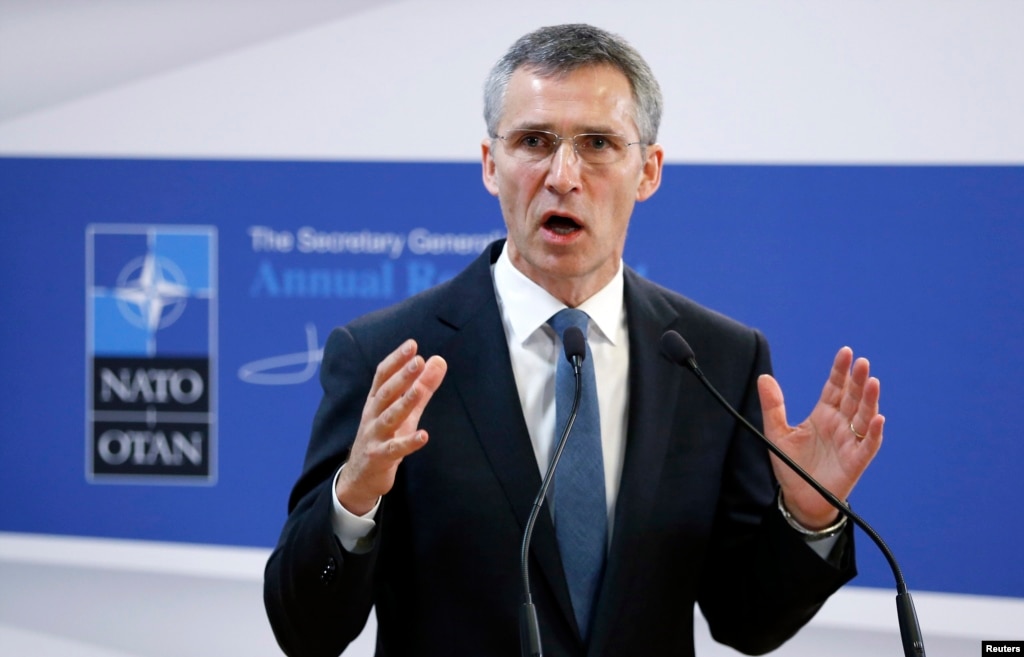 NATO Secretary-General Jens Stoltenberg
He said the moves were “a response to the aggressive actions we have seen of Russia violating international law and annexing Crimea,” the Black Sea peninsula Russia annexed from Ukraine in March after deploying troops and engineering a referendum Kyiv and the West say was illegal.
Stoltenberg said that “all practical cooperation” between NATO and Russia remains suspended and that a planned meeting with Russian Foreign Minister Sergei Lavrov at a February 6-8 security conference in Munich would be part of an effort to keep “channels for political dialogue” open.
NATO’s plans add to Western pressure on Russia, which Kyiv and the alliance accuse of arming, training, and aiding the rebels by sending military advisers and other troops into Ukraine to help them fight government in a conflict that has killed more than 5,350 people since April.
“We are calling on Russia to stop support for the separatists and to respect the Minsk agreement and use all its influence on the separatists to make them respect the cease-fire,” Stoltenberg said, referring to a deal on a cease-fire and steps toward peace signed in the Belarusian capital on September 5.
After weeks of fierce fighting in what the United States has called a “Russian-backed offensive” by the rebels, U.S. Secretary of State John Kerry was to hold talks with Ukrainian President Petro Poroshenko in Kyiv on February 5.
The meeting comes amid reports Washington may be close to reversing its policy not to arm Ukraine in its fight against Russian-backed rebels in the east of the country.
WATCH: At least five killed when shell hits hospital in Donetsk on February 4:
Washington has only provided “nonlethal” assistance to Ukraine, like night-vision goggles and radios.
U.S. President Barack Obama’s pick to run the Pentagon, Ashton Carter, said before the Senate Armed Services Committee on February 4 that he is inclined to support lethal weapons transfers to Kyiv.
Kyiv and Western governments believe Russia’s most modest goal is to weaken Ukraine by maintaining a “frozen conflict” in the east for years to come and fear President Vladimir Putin could support a rebel push to seize a swath of territory stretching from Donetsk to Crimea.
On February 3, a bipartisan group of 15 U.S. senators urged Obama and NATO to “rapidly increase military assistance to Ukraine to defend its sovereign borders against escalating Russian aggression.”
Despite sanctions imposed by the United States and the EU, the senators said that “Putin appears willing to gamble his country’s economy and world standing to further his blatant military invasion of another nation.”
The situation in eastern Ukraine has deteriorated severely in recent weeks amid a new surge in rebel activity.
At least five people were killed on February 4 when a shell hit a hospital in the rebel-held city of Donetsk.
The Ukrainian military said on February 5 that five soldiers had been killed in the previous 24 hours.
Fighting also continued around the government-held town of Debaltseve, northeast of Donetsk, where the military said it repelled two rebel attacks on its positions overnight.
EU foreign policy chief Federica Mogherini called on February 4 for an immediate cease-fire in Debaltseve, which links the cities of Donetsk and Luhansk, the two largest rebel strongholds.
Mogherini said the “spiral of ever-increasing violence in eastern Ukraine needs to stop” and blamed pro-Russian rebels for a recent escalation that she said was causing “great human suffering.”
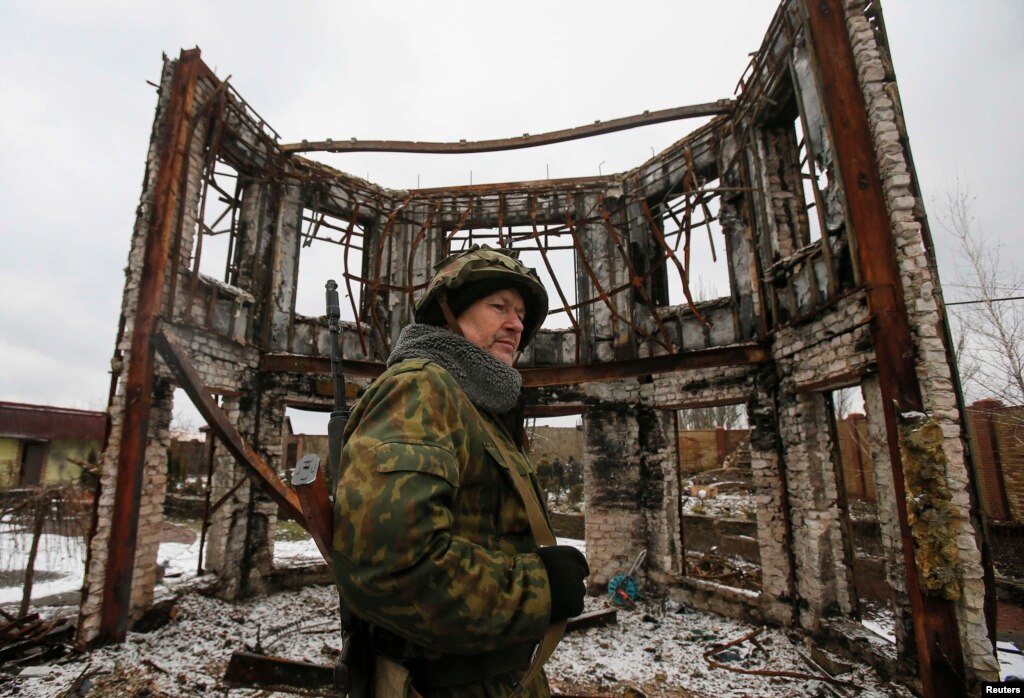 A rebel from the self-proclaimed Donetsk People’s Republic looks on near a building destroyed during battles with Ukrainian forces in Vuhlehirsk in the eastern Donetsk region on February 4.
Also joining calls for a cease-fire in Debaltseve was UN Secretary-General Ban Ki-moon.
“The rebel offensive continues and people are dying on a daily basis,” he said in a statement released by his spokesman.
In his congressional testimony, Carter said, “I think we need to support the Ukrainians in defending themselves.”
Carter also said Russia’s support for the rebels is “a clear violation” of a 1994 commitment.
The so-called Budapest Agreement “provided for Russia to respect the territorial integrity of Ukraine, which it’s obviously not done” Carter said.
Under that agreement, Ukraine agreed to give up the nuclear weapons it inherited from the former Soviet Union.
During a break in the confirmation hearing, White House spokesman Josh Earnest stressed that any decision to send arms to Ukraine would ultimately fall to Obama as commander in chief, but added that the president would listen to his advisers.
Some leaders in Europe, including German Chancellor Angela Merkel, have voice opposition to providing Ukraine with weapons, fearing it could spark a wider crisis with Russia.
In comments made in Kharkiv on February 3, Poroshenko expressed confidence that weapons deliveries from the United States and other Ukrainian “partners” would start soon.
Besides Poroshenko, Kerry is also due to meet on February 5 with Ukrainian Prime Minister Arseniy Yatsenyuk and Foreign Minister Pavlo Klimkin.
Kerry is not expected to announce plans to deliver lethal aid during his Kyiv visit, but Poroshenko will make his case for weapons supplies at the Munich Security Conference.
At the conference, Poroshenko is due to meet again with Kerry as well as U.S. Vice President Joe Biden, along with Merkel.
In an interview published on February 4 on European news sites, Biden said: “We have no interest in military escalation and are pushing hard for the reverse. But Ukraine has every right to defend itself and we are in fact providing security assistance to help Ukraine in this effort.”
Biden first travels on February 6 to Brussels, where he will join with Hagel for meetings with top NATO officials to discuss the situation in Ukraine.